
Add 10% wastage for a straight lay, 15% for diagonal and 20–25% for herringbone, then round up to full boxes. Allow more for large-format tiles and small or awkward rooms.
For adhesive, plan on about 2.5–3 kg per m² for standard tiles and 4–5 kg per m² for large format and floors. A 20 kg bag covers roughly 4–7.5 m², depending on the trowel.
Order too little and you end up with a second batch that doesn't quite match the first, plus a wasted trip to the merchant. Order too much and either your margin or your customer pays for it. Here's how to get the quantities right.
How much extra tile to allow
| Layout | Wastage to add |
|---|---|
| Straight lay (grid or brick bond) | 10% |
| Diagonal | 15% |
| Herringbone or chevron | 20–25% |
Move to the top of the range, or above it, when:
- the tiles are large format, because each broken or miscut tile wastes more;
- the room is small or has lots of corners, pipes, boxing or niches;
- the tile has a pattern that needs matching, or comes in varied shades;
- the tiles are fragile, such as some natural stone, glass and handmade tiles.
Always round up to full boxes. Leave the customer a few spare tiles from the same batch for future repairs. Shades vary between batches, and ranges get discontinued.
Example
A 14 m² kitchen floor in 600×600 mm porcelain, laid straight, needs 14 × 1.10 = 15.4 m². Boxes of 1.44 m² mean 15.4 ÷ 1.44 = 10.7, so order 11 boxes (15.84 m²).
How much tile adhesive you need
Adhesive use depends on the tile size, the trowel notch and how flat the surface is. Mapei's figures for a standard cement-based adhesive (Adesilex P9):
| Tile | Adhesive per m² |
|---|---|
| Mosaics and small tiles | about 2 kg |
| Standard wall and floor tiles | 2.5–3 kg |
| Large-format tiles, external floors | about 5 kg |
| Trowel (square notch) | Coverage of one 20 kg bag |
|---|---|
| 6 mm | 6–7.5 m² |
| 10 mm | 4–5 m² |
For large format, Mapei gives use by bed thickness: about 1.2 kg per m² for every mm of bed. A 4 mm bed is therefore about 4.8 kg/m². Back-buttering large tiles adds to that.
These are manufacturer guide figures. Check the data sheet for the adhesive you're actually using, and lift a tile early on to check you're getting full coverage. For more detail, see how far a 20kg bag of tile adhesive goes.
Grout
Grout use depends on the tile's length, width and thickness and the joint width. Narrow joints on large tiles use very little; wide joints on small or thick tiles use much more. Use the calculator for the grout you're using, which is usually on the manufacturer's website or the bag, rather than a single rule of thumb.
Most grout manufacturers use the same formula for grout per m²: (tile length + tile width) ÷ (tile length × tile width) × joint width × tile depth × 1.6, with all sizes in mm. For a 600×300 mm tile that's 9 mm thick, with 3 mm joints, that comes to about 0.22 kg per m². The same joint on 100×100 mm tiles comes to about 0.86 kg per m². Our material calculator works this out for you.
Everything else to count
- Primer: needed on gypsum plaster, plasterboard and screed before tiling.
- Levelling compound: worked out from area × average depth. Check the bag's coverage per mm.
- Tanking: a kit or membrane for every shower, bath surround and wet room area, including the joints between walls and floor.
- Trims: measure the length of each external corner and exposed edge, and allow for whole lengths.
- Silicone: for joints where tiles meet baths, trays, worktops and changes of direction.
- Spacers, levelling clips and wedges: especially for large format.
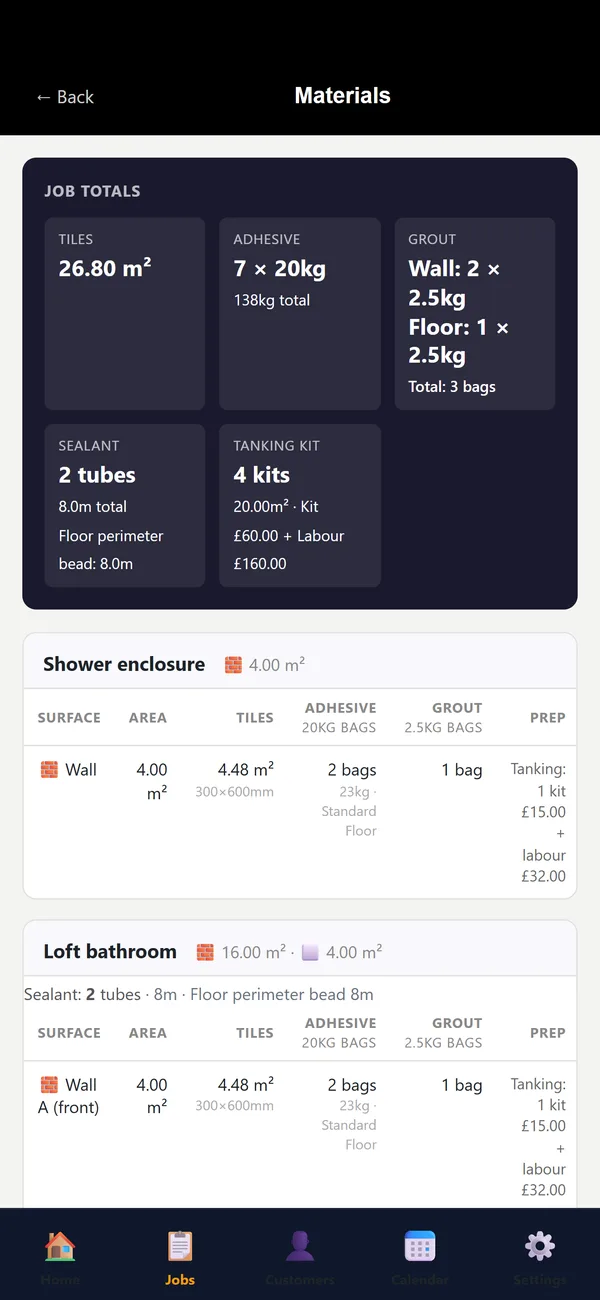
For a quick estimate for one area, try our free tiling material calculator.
Sources
- NC Tiles & Bathrooms: How to measure a room for tiling · UK retailer; wastage by layout
- Mapei Adesilex P9 technical data sheet · consumption per m² and coverage per 20 kg bag by trowel size
- Mapei Large Format Tile Adhesive technical data sheet · 1.2 kg/m² per mm of bed thickness
Prices change. Figures were checked on 20 October 2026; always check current costs and your own figures before quoting.